
Guides / Materials
Best filament for functional parts: choose by failure mode
There is no universal functional filament. Choose for heat, impact, stiffness, chemicals, UV exposure, flexibility and what your printer can process safely.

We haven't tested these products. This comparison is based on makers' published specifications and manuals, retailer listings and owner reviews (checked 15 November 2026).
Start here
“Functional” is a job description, not a filament type. Write down what can make the part fail—heat, impact, creep, chemicals, sunlight or repeated flexing—then choose a material your printer can process safely.
PLA is easy and stiff but is a poor default where sustained heat or creep matters. PETG is a common step towards tougher, less brittle parts. ASA can suit outdoor exposure but generally brings enclosure and ventilation considerations. Flexible materials solve impact and grip problems but demand an appropriate feed path. Fibre-filled materials can add stiffness while increasing nozzle wear and changing layer behaviour.
The Prusa material guide explicitly separates properties such as impact resistance, temperature resistance, UV resistance, flexibility and enclosure requirements. Turn the project into a list of failure modes before buying: will it soften, crack, creep, absorb moisture, see sunlight or contact a chemical? Then check the filament maker's technical and safety data. A decorative spool name such as “plus” does not replace a published datasheet.
Relevant Amazon UK listings
These are examples of the PLA+, PETG and flexible TPU categories discussed above, not substitutes for a technical datasheet or a printer-compatibility check.
- eSUN grey PLA+ filament, 1.75 mm, 1 kg: See it on Amazon UK
- SUNLU black PETG filament, 1.75 mm: See it on Amazon UK
- JAYO black TPU 95A filament, 1.75 mm, 0.5 kg: See it on Amazon UK
The common materials at a glance
This table condenses Prusa's individual material articles, opened on 15 November 2026. Temperatures are Prusa's own descriptions of where each material starts to struggle, not a guarantee for every brand; check the datasheet for the spool you actually buy.
| Material | Where it shines | Where it lets you down |
|---|---|---|
| PLA | Quick prototypes, jigs, display parts; no heated bed needed | Softens and deforms above about 60 °C, degrades in UV light, breaks along layers or into shards on impact |
| PETG | Mechanical parts indoors and most outdoor uses below about 80 °C; tough and humidity resistant | Needs a heated bed; supports are hard to remove |
| ASA | Outdoor and technical parts; UV and temperature resistance up to about 93 °C; acetone smoothing and gluing | Styrene fumes, high bed temperature, enclosure recommended, partially hygroscopic |
| TPU and other flexibles | Washers, bumpers, grips and high-stress parts that must flex; chemically and mechanically resistant | Stringing, absorbs moisture, softer grades are harder to feed |
| Polyamide (nylon) | Technical parts needing heat, chemical and mechanical resistance | Highly hygroscopic, warps, prints around 285 °C, needs ventilation or an enclosure |
| Carbon-, glass- or Kevlar-filled | Dimensional stability, less warping, higher temperature resistance and tensile yield strength | Usually lower impact resistance and layer adhesion; needs a hardened nozzle |
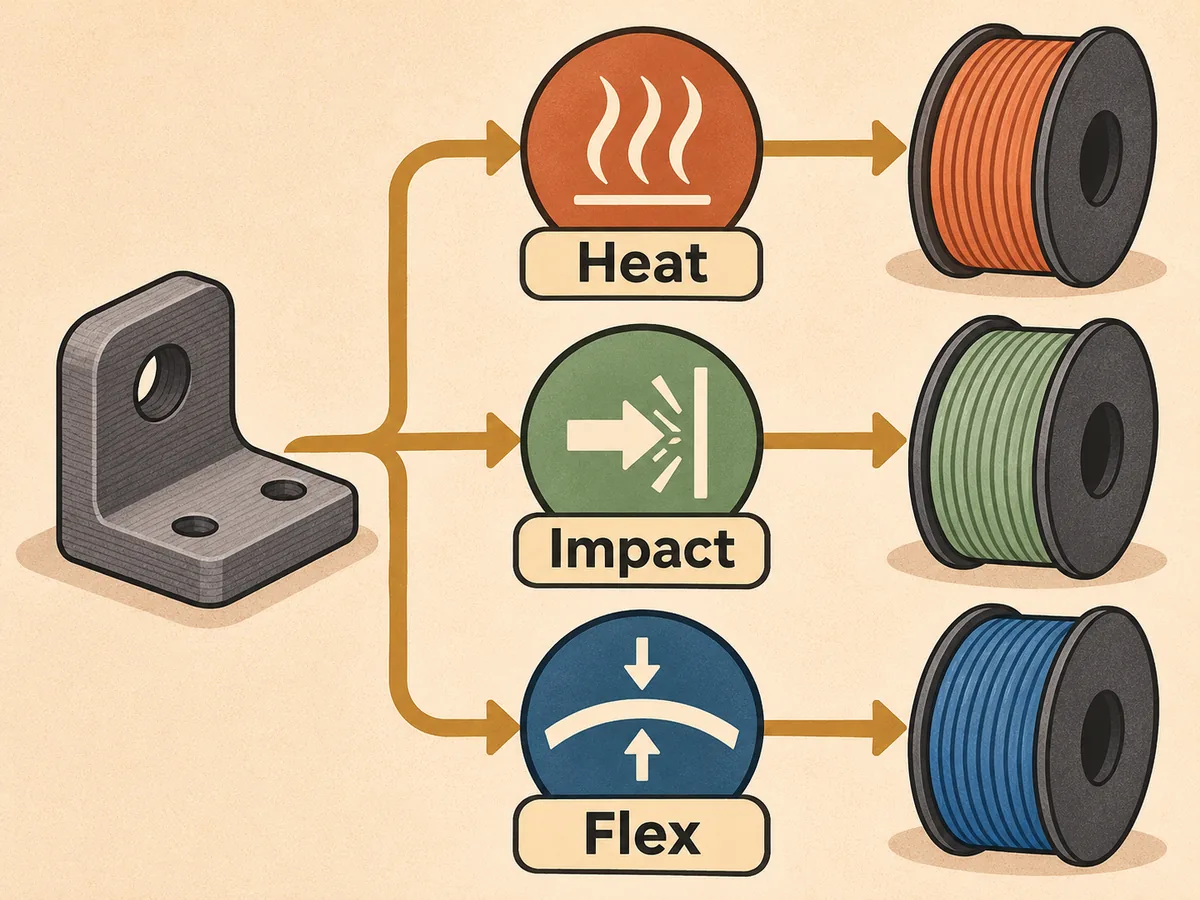
Heat is the failure you'll most often underestimate
The classic disappointment is a PLA bracket that is perfect on the bench and droops a few weeks later beside a radiator, in a sunny window or inside a warm enclosure. Prusa puts PLA's softening point at around 60 °C and explicitly calls it unsuitable for technical and outdoor use. If a part will sit anywhere warm, or carry a load continuously, start the shortlist at PETG and treat ASA or nylon as the step up when PETG's limit is too close for comfort.
Load matters as much as temperature. A clip that is stressed all the time is more likely to creep than one that only takes the occasional knock, so a part that is borderline on heat and permanently under load deserves the next material up, a thicker section, or both.
Sunlight and the outdoors
For anything living outside, UV is the second filter. Prusa says PLA degrades under UV light, describes PETG as suitable for mechanical parts both indoors and outdoors, and positions ASA as the outdoor technical material: a successor to ABS that is more UV resistant, warps less and smells less. A garden bracket or bike accessory is a reasonable PETG job; a part in full sun all summer on a car or shed roof is where ASA's extra headroom starts to justify the extra processing effort.
Stiffness versus toughness
Stiff and tough are not the same thing, and fibre-filled filaments show this clearly. Prusa's composite article says fibres improve dimensional stability, temperature resistance and tensile yield strength, but usually reduce Charpy impact resistance and layer-to-layer adhesion. So a carbon-filled PETG mount may flex less, yet crack sooner if it is dropped or struck across the layers.
When a part needs to survive knocks rather than hold a precise shape, PETG's toughness or a flexible TPU is often the better answer. When it needs to stay rigid and dimensionally stable, a filled grade makes sense, provided your nozzle is up to it. Our hardened-steel nozzle checklist covers that side.
For flexibles, Prusa notes that TPU is usually around 60A–90A on the Shore hardness scale, and that the softer the filament, the harder it is to print. A 95A TPU is a gentler starting point than a very soft grade, especially on a printer with a long feed path.
Can your printer actually run it?
Bambu Lab's filament compatibility table is a useful sanity check even if you own another brand. It groups ABS, ASA, PC and PA (and their fibre-filled versions) as needing higher bed and chamber temperatures to control warping and layer separation, and recommends an enclosed printer for them. PLA, PETG and TPU are listed as fine on open-frame or enclosed printers, though it still recommends an enclosure for PETG so low room temperatures do not weaken layer bonding.
The same page also warns the other way: for low-softening materials such as PLA and TPU, it recommends opening the door or removing the top of an enclosed printer when the bed is set above 45 °C, to stop filament softening inside the extruder. An enclosure is a tool for specific materials, not an automatic upgrade.
Fumes, ventilation and the room you print in
The engineering materials bring an air-quality question. Prusa says ASA releases potentially dangerous fumes (styrene) and should be printed in a well-ventilated area, while warning that a draught across the print will hurt the result. Its nylon article says printing in a well-ventilated room or an enclosure is a must because of ultrafine particles. In a small UK spare room or a home office, that can be the deciding factor between ASA and PETG for an outdoor part. Follow the printer maker's guidance on enclosures and filtration, and the filament maker's safety data sheet.
Keep hygroscopic spools dry
Several functional materials are hygroscopic. Prusa recommends drying nylon for at least four hours below 90 °C and keeping it airtight with desiccant, noting that moist nylon forms bubbles and leaves uneven layers. It flags TPU and ASA as moisture-absorbing too. Bambu Lab's guide advises drying engineering materials before use and keeping filament sealed with desiccant while printing. Use the drying temperature on your own spool's label, since it varies by brand and blend.
Then tune the profile
Once the material is chosen, start from the slicer's profile for that filament type and calibrate it. OrcaSlicer's calibration documentation suggests the order temperature, volumetric speed, pressure advance, flow ratio, then retraction. For functional parts, the temperature step matters most: printing at the cold end of a range can produce neat-looking layers that bond poorly.
The short version
Choose against the real failure mode and check the filament maker's technical and safety information before buying. If the job asks for conflicting properties, change the geometry or assembly as well as the spool; no decorative “plus” label makes one polymer universal.
Sources
- Prusa Knowledge Base: filament material guide
- Prusa Knowledge Base: PLA
- Prusa Knowledge Base: PETG
- Prusa Knowledge Base: ASA
- Prusa Knowledge Base: flexible materials
- Prusa Knowledge Base: polyamide (nylon)
- Prusa Knowledge Base: composites filled with carbon, Kevlar or glass
- Bambu Lab Wiki: filament guide and compatibility table
- OrcaSlicer calibration documentation