
Guides / Nozzles and tools
Best hardened-steel nozzles: a UK compatibility checklist
The best wear-resistant nozzle is the one that fits the hotend, suits the filament and has a profile you can tune. Thread, length and thermal behaviour matter.
We haven't tested these products. This comparison is based on makers' published specifications and manuals, retailer listings and owner reviews (checked 15 November 2026).
Start here
A hardened nozzle is only an upgrade when it actually fits the hotend and matches the filament. Check the exact family, thread, length and installation instructions before the shiny material name tempts you into the wrong part.
Prusa recommends hardened steel for abrasive composites that can wear a standard brass nozzle quickly, and warns that different thermal conductivity may require a temperature adjustment. That makes compatibility more important than a generic marketplace claim. Confirm the exact nozzle family, thread, overall geometry, diameter marking and installation procedure in the printer or hotend manual.
For occasional plain PLA or PETG, brass remains easy to heat and inexpensive. Hardened steel earns its place for carbon-filled, glow or metal-filled materials when the filament maker calls them abrasive. Coated copper and specialist wear-resistant tips occupy other trade-offs, but a premium material cannot correct the wrong dimensions. A 0.6 mm or larger bore may reduce blockage risk with particle-filled filament; follow the filament maker rather than assuming every composite is the same.
Relevant Amazon UK listings
These listings illustrate why the printer and hotend name matter more than the words “hardened steel”. Check the complete geometry and the printer maker's instructions before ordering or fitting one.
- QIDI Q2 0.4 mm bimetal nozzle with a hardened-steel tip: See it on Amazon UK
- Flashforge Creator 5/5Pro 0.4 mm quick-swap hotend nozzle: See it on Amazon UK
- Anycubic Kobra X/Kobra 3 0.4 mm hardened-steel nozzle pair: See it on Amazon UK
Which filaments actually call for one
You'll often see “abrasive” used loosely, so it helps to know what the makers themselves list. Prusa's E3D V6 nozzle article names carbon-fibre composites, bronze- and steel-filled filaments and some glow-in-the-dark filaments as examples, and adds a sensible instruction: ask the filament vendor if you are not sure.
Bambu Lab's filament and nozzle compatibility table is more explicit. It marks a hardened-steel nozzle as required for carbon- and glass-fibre grades (PLA-CF/GF, PETG-CF, ABS-GF, PA-CF/GF, PET-CF/GF and higher-temperature engineering composites) and for particle-filled grades such as its Marble, Sparkle and Glow PLAs. Plain PLA, PETG, TPU, ABS and ASA are listed as not requiring one. The same page says brass and stainless steel lack the hardness for those filled materials and wear quickly, which then affects print quality.
So the practical test is simple. If every spool you own is unfilled PLA, PETG or TPU, a hardened nozzle mostly buys you peace of mind for later. If you plan to print fibre-filled or glitter-style filament even occasionally, it is the part to fit first.
Brass, hardened steel, coated and ruby tips compared
Each wear-resistant option trades something away. These summaries come from Prusa's nozzle article and the Simplify3D carbon-fibre materials guide, both opened on 15 November 2026.
| Nozzle type | What the makers say it is good for | The catch |
|---|---|---|
| Brass | Excellent heat conductivity; prints most common filaments | Wears quickly with abrasive fillers |
| Hardened steel | Abrasive composites, metal-fill and glow filaments | Lower thermal conductivity; Prusa suggests about 5 °C hotter and notes ABS cannot be printed as fast |
| Coated nozzle (E3D Nozzle X, WS2 coating) | Glass, Kevlar and carbon fillers, with less plastic sticking inside | Not for boron carbide, boron nitride or tungsten-type fillers; needles, brass brushes and cold pulls can damage the coating |
| Brass body with ruby tip (Olsson Ruby) | Highly abrasive materials while keeping brass-like heat transfer | The gemstone is brittle and can crack if the nozzle strikes the sheet |
Simplify3D goes further than Prusa on temperature, saying a hardened hotend may need the extruder set as much as 40 °C hotter than usual. The two figures are not a contradiction so much as a range: the right offset depends on the nozzle, the hotend and the flow you are asking for, so start from the filament maker's range and adjust in small steps.
For a concrete example of what “hardened” means on a printer-specific part, Bambu Lab's hotend replacement page lists its X1/P1 hardened option as a heat-treated mould-steel tip rated HRC 55–60, sitting in a nickel-plated brass heater block. That is a useful reminder that a nozzle is part of an assembly, not just a tip.
Picking a bore size for filled filament
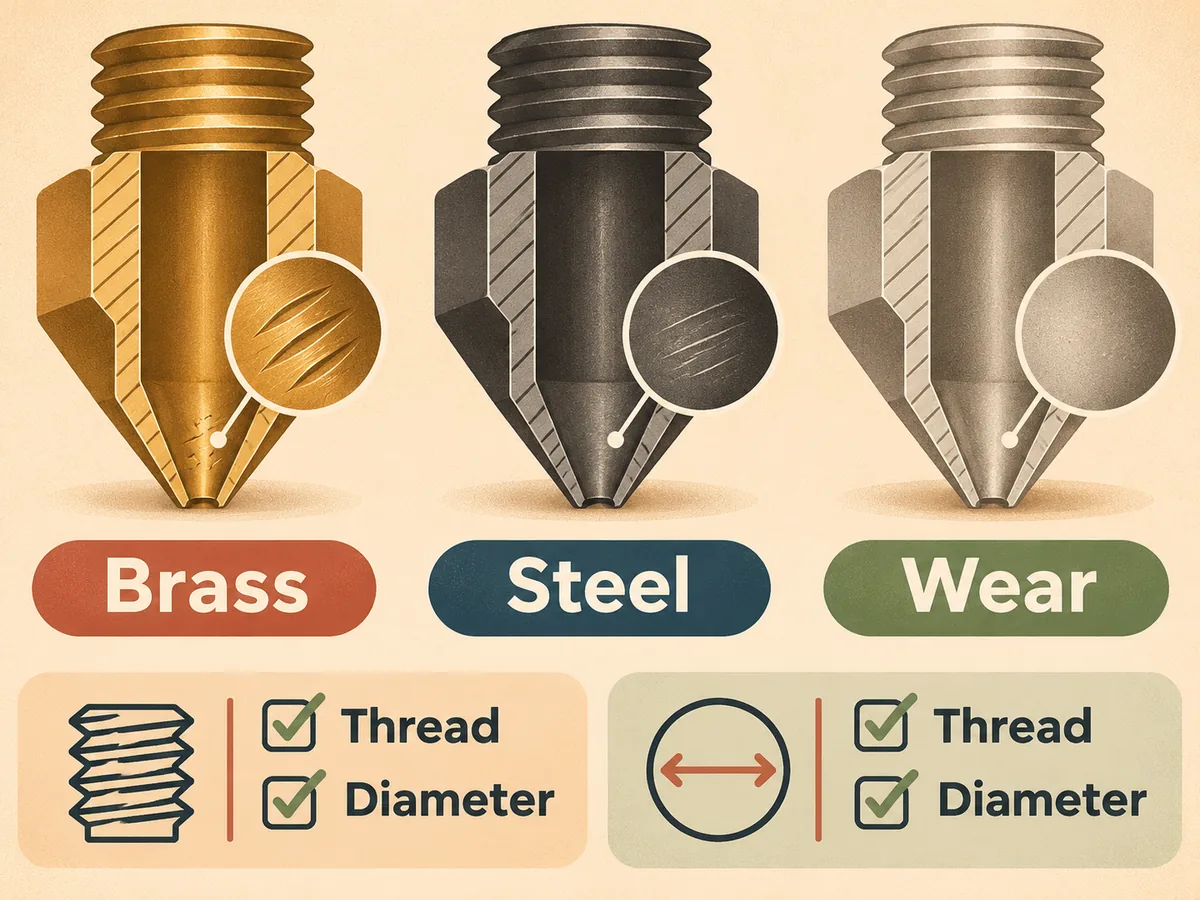
Diameter matters as much as material with composites. Bambu Lab's table says to avoid a 0.2 mm nozzle with fibre- and particle-filled filament because the clogging risk is extremely high. Its first choice is a 0.6 mm hardened nozzle; 0.4 mm is the second choice for better detail, with a suggested layer height of 0.15–0.3 mm and a maximum speed of roughly 100 mm/s. The same page notes that going from 0.4 to 0.6 to 0.8 mm loses detail but lowers clog risk, and that the nozzle and extruder gears need more frequent maintenance with these materials.
The filament path matters too. Simplify3D points out that carbon-fibre filament is more brittle than its base polymer and can snap on tight bends or sharp frame edges, so it recommends a path of gentle curves from spool to nozzle. Bambu's table similarly warns that some brittle or rough composites can break inside, or wear, the AMS feed channels. If you use an automatic material system, check that table before loading a filled spool.
Matching the nozzle to the hotend
“V6-compatible” is the most common claim you'll see, but it only helps if your hotend really takes V6 nozzles. Prusa's article covers E3D V6 nozzles and a separate Nextruder V6 adapter, which tells you that even within one maker's range the nozzle standard can change between printer generations. Before ordering, confirm:
- The hotend family: V6-style threaded nozzle, a longer high-flow format, or a printer-specific quick-swap or one-piece hotend.
- Thread and overall length: a nozzle that bottoms out on the heater block before it seals against the heat break will leak.
- The diameter marking: Prusa notes its E3D 0.4 mm nozzles carry three dots, while a 0.25 mm V6 nozzle has none and looks almost identical to a 0.4 mm nozzle shipped on another model.
- Multi-material support: Prusa states it provides MMU2S presets only for brass nozzles, so hardened or exotic nozzles may cause issues there.
On printers with a one-piece hotend the decision is made for you. Bambu Lab sells its hotends as a single unit with heatsink, throat, heater block and nozzle, in hardened or stainless steel and 0.2–0.8 mm sizes, and says they can be swapped cold. It also reminds you to update the nozzle information on the printer screen after fitting a different specification, otherwise the printer assumes the old one.
Fitting a threaded nozzle without a leak
Threaded nozzles are usually tightened hot. Prusa's MK3-series nozzle change guide heats the hotend to 280 °C, uses a 7 mm spanner or socket on the nozzle while a second spanner holds the heater block, and states that its service team tightens nozzles to 2.5 N m with a 1–5 N m torque wrench. It also asks you to check for a small gap (about 0.5 mm) between nozzle and heater block afterwards. Other hotends have their own temperature and torque values, so follow the procedure for your exact model rather than borrowing these numbers.
The safety point is not optional: the guide warns that heated parts can cause severe burns. Put the old nozzle on a non-flammable surface, keep the printer on its nozzle-change screen so the temperature does not change, and never hold the heater block by hand.
After the swap: re-tune the profile
A new nozzle material changes heat transfer, so expect to revisit the filament profile. OrcaSlicer's calibration documentation suggests running its tests in the order temperature, volumetric speed, pressure advance, flow ratio, then retraction. With hardened steel the temperature and volumetric speed steps matter most, because a profile that was right for brass can quietly under-extrude at the same speed.
The short version
Compatibility comes first, abrasion resistance second and tuning third. Confirm the dimensions in the printer or hotend manual, follow the documented fitting procedure and expect thermal behaviour to differ from brass. The best nozzle here is the correct one, not the most exotic one.
Sources
- Prusa Knowledge Base: E3D V6 nozzles, including abrasive materials, Nozzle X and Olsson Ruby
- Bambu Lab Wiki: filament guide with nozzle and printer compatibility table
- Bambu Lab Wiki: replacing the hotend on X1 and P1 printers
- Prusa Knowledge Base: changing or replacing the nozzle on MK2.5/MK3-series printers
- Simplify3D materials guide: carbon-fibre-filled filament
- OrcaSlicer calibration documentation